
Sanilac County Supervision Paths
Three systems can place a person under conditions in Sanilac County. MDOC parole follows release from a Michigan state prison while the person remains in the legal custody of the Michigan Department of Corrections. MDOC felony probation is different. It is a community sentence ordered through the 24th Circuit Court and may involve little or no prison time. A third path belongs to 73A District Court, which handles misdemeanor probation and pretrial reporting tied to a pending case or bond order.
The court and sentence identify the right channel. A felony parolee or felony probationer may appear in the MDOC Offender Tracking Information System, known as OTIS. A person on misdemeanor probation or ordered to report while a case is pending should instead be checked through the 73A District Court case and local office. Selecting “Probationers” in OTIS cannot confirm a District Court term.
| Status | How it begins | Best public check | Local office |
|---|---|---|---|
| MDOC parole | Release from state prison under supervision | OTIS Parolees status and sentence record | MDOC Sanilac office |
| MDOC felony probation | 24th Circuit Court community sentence | OTIS Probationers status and court case | MDOC Sanilac office |
| District Court probation | Misdemeanor sentence | 73A court order and probation office | Courthouse Room 311 |
| Pretrial reporting | Condition in a pending case | Bond order and Pretrial Services | Courthouse Room 311 |
Verify Sanilac County Parole
A reliable supervision check starts with identity, not just a similar name. OTIS accepts an MDOC number, which is the strongest search key. When that number is unknown, use the person’s name and narrow the results with available identity details. The status filter should match the question: Parolees for release from prison, Probationers for felony probation, or the corresponding absconder filters for a reported supervision failure.
- Open the official OTIS search and use the MDOC number when available.
- Choose the Parolees, Probationers, Parole Absconders, or Probation Absconders filter that fits the inquiry.
- Compare the full identity, MDOC number, sentence county, case number, and any image date before relying on a match.
- Read the current status and supervision location. An office listing is an assignment, not a home address or the person’s present location.
- Call the displayed field office to ask which public channel can confirm whether the status and assignment remain current.
- For a misdemeanor or pretrial case, leave OTIS and confirm the 73A District Court order instead.
OTIS warns that its status, location, and projected date information may not be current. A direct office check or releasable agency record gives stronger confirmation. The broader Sanilac County released inmate search explains how to distinguish a jail release, state-prison release, and transfer before checking supervision.
Sanilac County Parole Office
Sanilac County has a local combined MDOC parole and probation office rather than only a statewide contact line. It serves the 24th Judicial Circuit as part of MDOC Field Operations Administration Region 6. The county describes its work as investigation and supervision for an adult felony population. This is the correct local point for a current OTIS office assignment, subject to limits on what staff may disclose.
MDOC Sanilac County Parole/Probation
Sanilac County Courthouse, Room 112
60 W. Sanilac Road
Sandusky, MI 48471
(810) 648-4546
Fax: (810) 648-5452
Monday through Friday, 8 a.m. to 5 p.m.
73A District Court Probation
Sanilac County Courthouse, Room 311
60 W. Sanilac Road
Sandusky, MI 48471
(810) 648-3910
Misdemeanor probation; Pretrial Services uses extension 3.
The successful MDOC Region 6 directory capture shows the Sanilac office contact used for local verification.
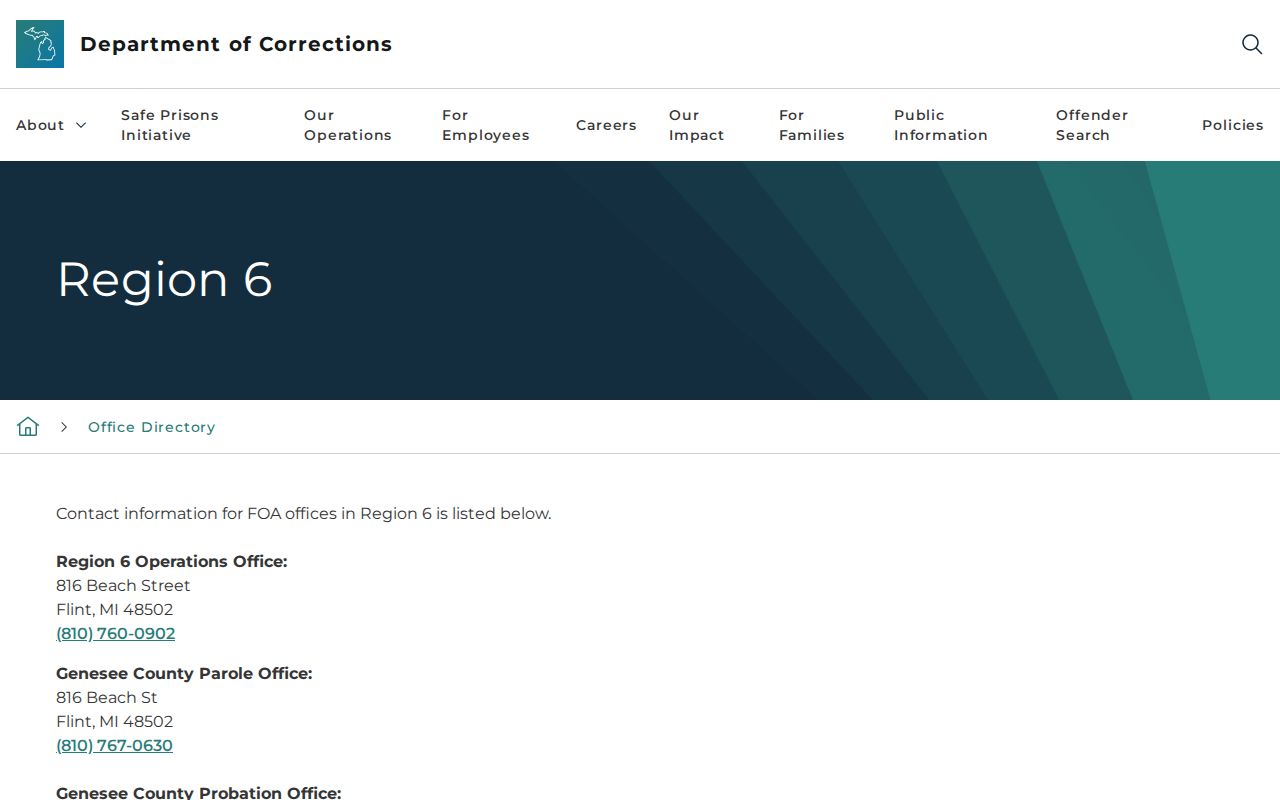
The directory image helps confirm the office route, but OTIS and the office must still be matched to the correct person and case.
Sanilac County Reentry Support
Sanilac’s local system separates reentry planning from court supervision. The Sheriff Corrections Division states that education, mental-health services, addiction treatment, and reentry planning are available in the jail. The source does not promise that every released person receives a specific service or remains enrolled after leaving custody. It does show that planning may begin before a jail release.
Community Corrections and Pretrial Services share Courthouse Room 311, yet their roles are not the same. Community Corrections helps navigate local court-based programming. Pretrial Services handles reporting imposed while a case is still pending. The MDOC office in Room 112 handles state felony parole and probation. A person described only as “released under conditions” may belong to any of these paths, so the court order and assigned agency should guide the next call.
Reentry support does not prove parole. Nor does a required check-in always mean a conviction. Pretrial reporting can arise from a bond order before final disposition. Read the legal status first, then ask the named office about public instructions and current reporting channels.
Sanilac County Absconder Status
An absconder label means supervision reports that the person stopped complying or cannot be located. It does not mean the supervision term ended. OTIS offers separate filters for parole absconders and probation absconders. When a profile carries that status, its supervision location is the last assigned office, not a statement of the person’s current whereabouts.
Do not attempt to find or confront an absconder. MDOC publishes an absconder and escapee tip line at 517-755-0855. For immediate danger, use emergency services. For a record question, compare the OTIS profile with the 24th Circuit Court case and contact the assigned office. A court warrant or violation proceeding may add context, but public access can vary and the court entry does not replace MDOC’s current supervision record.
- Parole
- Community supervision after release from a state prison sentence.
- Probation
- A court-ordered community sentence or term that is not the same as parole.
- Absconder
- A reported supervision status for a person who cannot be located or is alleged to have stopped complying.
- Revocation
- A formal action that can return a person to custody after a proved violation.
- Discharge
- The end of MDOC sentence supervision, distinct from release on parole.
Note: A missing name, old office assignment, or similar-name result is not enough to establish a violation, warrant, or discharge.
Sanilac County Parole Hearings
The Michigan Parole Board is the sole paroling authority for felony offenders committed to MDOC. Eligibility is not a promise of release. MCL 791.234 controls when the Board gains jurisdiction, while MCL 791.233 requires reasonable assurance that release will not pose a public-safety risk. Offense, sentence, and date rules matter, especially for life terms.
Most ordinary prisoner interviews do not appear on a full public calendar. The prisoner receives direct notice and is responsible for informing a chosen representative. The official public-hearing registration page is instead a rolling set of notices chiefly for public lifer parole and clemency matters. MDOC says those notices appear about two weeks to 30 days before a hearing. Each notice supplies the date, remote access or registration rules, and deadline.
The official public-hearing page capture below shows the rolling notice route rather than a person-level decision database.
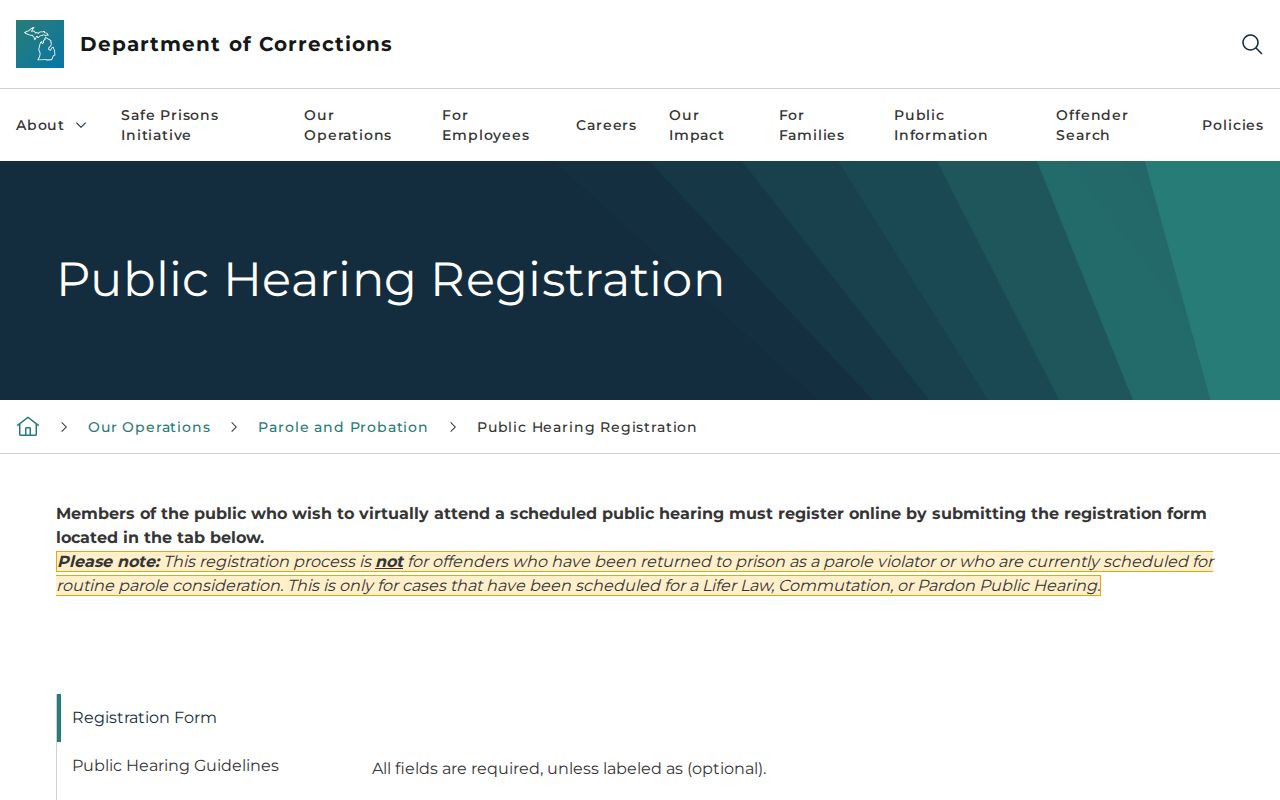
No public database was found for every individual parole decision. Quarterly reports provide aggregate categories such as granted, denied, and deferred. For one person, use OTIS status and dates, the field office, and a releasable Board record.
Sanilac County Parole Release
A Board grant does not mean a person has already walked out of prison. MDOC says consideration often begins months before an eligibility or reconsideration date, and interviews commonly occur by secure video. Most decisions use three-member panels. The Parole Release Unit then documents the decision, parole date, supervision term, and special conditions while coordinating community placement.
The official process generally leaves at least 28 days between the Board’s release decision and physical release. Misconduct or new adverse information can suspend a grant. That is why a hearing notice, eligibility date, or favorable decision should not be reported as the actual release event. OTIS may later show Parolee status and an assigned field office once release occurs.
MI-VINE serves a narrower notification role. County jail notices expressly cover release, transfer, and escape, while MDOC coverage is described as general release. Direct victims who seek the broader set of parole-hearing and decision notices must register separately with MDOC Crime Victim Services. One subscription should not be assumed to cover every Board event.
Sanilac County Supervision Discharge
Supervision ends through a formal discharge, not merely because a profile disappears or a person stops reporting to one office. A discharged OTIS profile can display “Current Status: Discharged” and a Discharge Date. Inactive sentence blocks may also show a discharge date and reason. By contrast, a parolee remains under MDOC custody in the community, and a probationer remains subject to the court sentence.
OTIS generally retains people discharged from MDOC supervision for three years. Older records may require the sentencing court or MDOC records channels. A set-aside can also affect public display. District Court probation ends under the local court’s order, so that case record and probation office are the right sources. Preserve a matching discharge record or court order when the end date matters.
Note: A parole eligibility date, maximum discharge date, and actual discharge date are separate fields and should never be used as synonyms.