
Sanilac County Release Date Meanings
Michigan OTIS does not label its main prospective field “projected release date.” It uses Earliest Release Date, or ERD. For an indeterminate state sentence, ERD marks when the controlling minimum has been served and the Michigan Parole Board may gain jurisdiction, after any legacy credits that lawfully apply. It is not an appointment at the prison gate and does not compel a parole grant.
Maximum Discharge Date is the outside endpoint of MDOC sentence custody if the person is not earlier paroled and discharged, subject to the controlling sentence calculation. A completed profile can instead show Discharge Date, which records the actual end of MDOC supervision. County jail records use their own booking, release, sentence, and transfer entries rather than this state-prison framework.
- Earliest Release Date
- The first date at which the Board may gain jurisdiction under the controlling minimum and applicable law.
- Maximum Discharge Date
- The outside MDOC sentence endpoint shown by the state calculation.
- Discharge Date
- The recorded date MDOC sentence supervision ended.
- Actual jail release
- The physical custody event recorded by the Sheriff, which may follow bond, court order, time served, completion, or transfer.
Choose Sanilac County Release Records
The right date source follows the custody system. Someone held at Sanilac County Jail before trial does not gain an OTIS ERD simply because the jail is in Michigan. Bond may authorize release, but a detainer or another valid hold can delay the physical event. The Sheriff’s custody transaction gives the release or transfer time, while the 73A District Court or 24th Circuit Court file explains the legal order.
| Person’s status | Date source | What to confirm |
|---|---|---|
| Pretrial at Sanilac County Jail | Court bond/order plus Sheriff custody record | Whether another hold blocks release |
| Serving a county jail sentence | Judgment, credited time, and Sheriff transaction | Actual local sentence calculation |
| Serving an MDOC prison sentence | OTIS sentence profile | ERD, controlling sentence, and Board status |
| Released from prison on parole | OTIS Parolee status and MDOC record | Actual parole date and supervision office |
| Federal BOP prisoner | BOP Inmate Locator | Federal release date and remaining custody or supervision |
A person removed from the Sanilac jail search may have transferred to MDOC, USMS, another county, or another agency. Search the receiving system before calling that removal a release to the community. The Sanilac County released inmate record path covers the full cross-system confirmation sequence.
Find Sanilac County Projected Release
Start with the person’s case and custody type. An MDOC number is the strongest key for a state prisoner. When it is unavailable, search by name and use the identity, sentence county, case number, and image date to avoid a false match. Sanilac County should appear in the sentence information when the state term arose from a local case, but the assigned prison may be elsewhere in Michigan.
- Confirm whether the person is in county jail, an MDOC prison, federal custody, or another agency’s custody.
- For MDOC, open the official OTIS search and use the MDOC number or identifying details.
- Open the correct profile and compare the county, case, identity, sentence blocks, and current status.
- Read Earliest Release Date, Maximum Discharge Date, and any actual Discharge Date as different fields.
- For a jail sentence or pretrial stay, obtain the court order and ask the Sheriff for the release or transfer transaction.
- Confirm a material date with MDOC, the sentencing court, or the jail because online estimates and statuses can change.
The successful OTIS search-field capture shows the status filters and identity fields available at the state entry point.
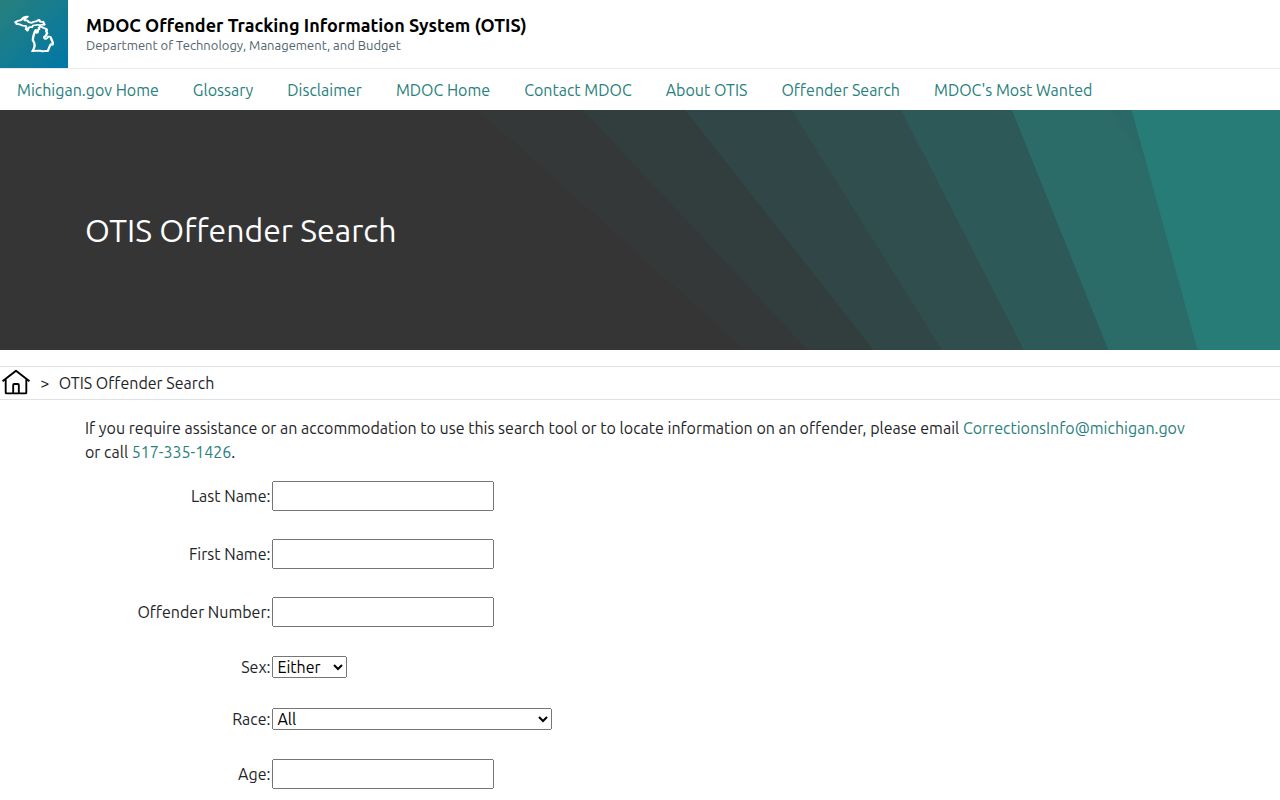
The search screen helps locate a profile, but the profile’s sentence blocks and agency confirmation determine how the displayed date should be understood.
Michigan Release Date Sentencing Rules
Michigan does not apply a blanket rule requiring every prisoner to serve about 85 percent of a sentence. The official MDOC Truth in Sentencing explanation says that, for covered offenses, the person must serve 100 percent of the judicial minimum in prison before parole consideration. The rule applies to specified assaultive crimes committed on or after December 15, 1998 and other covered crimes committed on or after December 15, 2000.
Truth in Sentencing removed good time, disciplinary credits, and corrections-center service as ways to reduce that minimum. MCL 791.234 governs Board jurisdiction and sentence timing. MCL 800.34 and 800.35 address disciplinary-credit and disciplinary-time distinctions. Disciplinary time may accumulate for Class I misconduct and be considered by the Board, but it is not simply good time run backward.
The court sets an indeterminate minimum and maximum within Michigan law. Parole may be considered after the controlling minimum, but the Board can deny release and reconsider later. MCL 791.233 sets substantive parole conditions, including the public-safety assessment. An ERD is thus the start of possible Board jurisdiction, not a fixed release order.
Note: State Truth in Sentencing rules do not calculate a Sanilac County Jail bond-out or create a county 85-percent formula.
Sanilac County Legacy Sentence Credits
Older Michigan offense dates can bring different credit rules into a state projected release calculation. MDOC’s glossary says good time applies to crimes committed before April 1, 1987. The amount generally ranges from five to 15 days per month based on sentence length, with possible exemplary time. This is legacy law, not a credit available for every current sentence.
Eligible offenses after April 1, 1987 but before the applicable Truth in Sentencing date can receive disciplinary credits of five days per month plus two exemplary days, up to 84 days per year. Major misconduct can cause a loss. Consecutive sentences, multiple sentence blocks, offense dates, and a change in the controlling sentence make a manual estimate unsafe.
No official Sanilac County jail good-time or weekend-release formula was found in the reviewed sources. A local jail date follows the court sentence, credit for time served, bond or other order, valid holds, and the Sheriff’s custody entries. Do not transfer old MDOC credit math to a county sentence.
Why Sanilac Release Dates Change
A displayed estimate can move for reasons found in the sentence, court record, agency record, or parole process. OTIS warns that projected release data may not be current. Each change should be traced to the office that made or recorded it rather than guessed from a new screen value.
| Factor | Possible effect | Best confirmation |
|---|---|---|
| Sentence amendment or appellate relief | Changes a minimum, maximum, or controlling term | Sentencing court order and MDOC update |
| Jail credit correction | Changes credited time applied to the sentence | Judgment and MDOC sentence record |
| Consecutive or concurrent treatment | Changes how sentence blocks combine | Court judgment and MDOC calculation |
| Legacy credit loss or restoration | Moves an eligible old-law calculation | MDOC sentence record |
| Parole denial or reconsideration | Leaves custody in place after ERD | Board record and OTIS status |
| New sentence or detainer | Creates another custody basis | Court and holding agency |
| Data correction | Changes a public field without a new release event | MDOC records office |
A parole grant can also be suspended before physical release because of misconduct or new adverse information. Likewise, a bond order can authorize a county release while another agency’s hold prevents the person from leaving custody. The legal decision and the physical event must both be checked.
Federal Release Dates Near Sanilac
A federal release date does not belong in OTIS or MI-VINE. The BOP Inmate Locator may show a past release date and “RELEASED” as the location for a person formerly in federal prison. A future date is an estimate. “UNKNOWN” and “IN TRANSIT” also have distinct federal meanings, and “RELEASED” does not guarantee that no other custody or supervision remains.
The official BOP record explanation shown below defines how its date and location labels should be read.
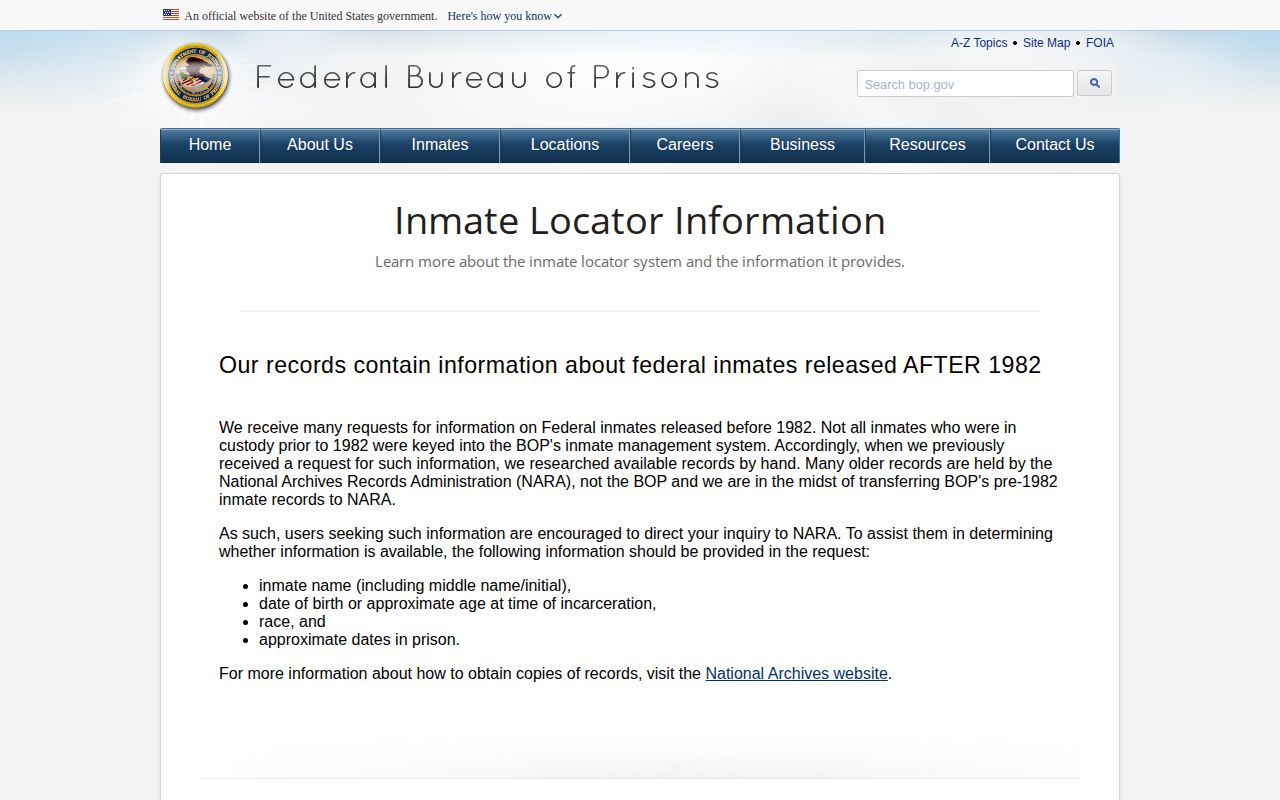
The BOP explanation keeps a federal prison estimate separate from a Sanilac jail record, MDOC ERD, federal court order, or USMS pretrial custody event.
Federal pretrial detention can be managed through the court and USMS rather than a BOP sentence profile. If a person was only housed in Sanilac County Jail for another agency, request the Sheriff’s transfer entry and follow the agency identified there.
Confirm Sanilac County Release Dates
Confirmation pairs the prospective field with the later custody event. For MDOC, compare the profile’s ERD with current status and then contact the agency or field office. A profile showing Parolee supports release from prison under supervision. A profile showing Discharged and an actual Discharge Date supports the end of MDOC supervision, generally within OTIS’s three-year public window.
For Sanilac County Jail, call the jail information line and request the existing release or transfer transaction when documentary proof is needed. The court’s bond order, judgment, dismissal, or amended order explains legal authority, while the Sheriff records the physical change. A live roster or app is a current-status clue only.
When an outside agency supplied the hold, ask which agency received the person and follow that system. Sanilac’s bed-rental use makes this check especially important because local physical custody does not always mean a local sentence or local release decision.
A pending event can also be watched through the Sanilac County VINELink inmate search. Register on the correct person record and verify any alert with the reporting agency. County events may include release, transfer, or escape; MDOC coverage is described as general release. The alert is not a substitute for an agency record.
For a durable state record, MDOC accepts public-record requests through its FOIA process. A useful request identifies the person and MDOC number, the sentence or Sanilac case, and the exact date field or release record sought. For a county event, describe the booking and date range to the Sheriff Records Bureau. Ask for an existing record, not a fresh release-date calculation or legal explanation.
Michigan FOIA generally calls for a response within five business days and allows one extension of up to ten business days under MCL 15.235. A response may grant access, deny access with legal grounds and appeal information, or seek a permitted extension. The timeline is a response rule, not a promise that every requested field is public or that an estimate will remain unchanged.
Note: Record the field label and source with every date so an ERD, maximum date, parole date, jail release, and discharge are not conflated.